Showing posts with label Timber work. Show all posts

Tuesday, March 25, 2014

Timber Works 04-Timber Joints


Timber joints are used to join timber parts in a structure. Timber needs to be joined in 03 positions when making timber structures:
1.      Lengthening
2.      Widening
3.      Angled or Cross
Halving Joints
A halved joint is formed by removing material from each at the point of intersection so that they overlap. The two members can be joined either on the flat or on the edge. When joined on the flat it is termed a lap joint.
The simple halved joint is created by cutting a slot in opposite edges of the members to be joined so that they slip together. Most commonly, the amount of material removed is equal to half the width of the members being joined, although this depends on the relative dimensions of the members. This joint is relatively weak and prone to splitting, due to the lack of shoulders which would otherwise prevent twisting. When extra strength is required, a strengthened version of the joint is called for. This involves a more elaborate cut out which incorporates shoulders to prevent twisting of the joint.
                                    

                 End Lap Joint                                                                       Tapered end lap joint


                           Halving joint with bolts                                             Angled halving joint


     Cross halving joint                Dovetailed cross halving                   Oblique halving


Mortise &Tenon Joints
The mortise and tenon joint is one of the oldest timber joints. This joint is used to join pieces of wood, mainly when the adjoining pieces connect at an angle of 90°. In its basic form it is both simple and strong. Although there are many joint variations, the basic mortise and tenon comprises two components: the mortise hole (female) and the tenon (male). A mortise is a cavity cut into a timber to receive a tenon. The mortise is usually 1/3 thickness of the member. A tenon is a projection on the end of a timber for insertion into a mortise. Usually the tenon is longer than it is wide. The tenon, formed on the end of a member generally referred to as a rail, is inserted into a square or rectangular hole cut into the corresponding member. The tenon is cut to fit the mortise hole exactly and usually has shoulders that seat when the joint fully enters the mortise hole. The joint may be glued, pinned, or wedged to lock it in place.


Haunched Mortise &Tenon                                                                   Wedged Mortise &Tenon

Bridle joint
Bridle joint is similar to mortise &tenon, in that a tenon is cut on the end of one member and a mortise is cut into the other to accept it. The distinguishing feature is that the tenon and the mortise are cut to the full width of the tenon member. The corner bridle joint (also known as a slot mortise and tenon) joins two members at their respective ends, forming a corner. This form of the joint is commonly used to house a rail in uprights, such as legs. It provides good strength in compression and is fairly resistant to Stacking, although a mechanical fastener or pin is often required. Corner bridles are often used to join frame components when the frame is to be shaped. Material can be removed from the joined members after assembly without sacrificing joint integrity.
A variation of the bridle joint is the T-bridle, which joins the end of one member to the middle of another.


Corner Bridle Joint


‘T’ Bridle joint.


Timber products.
Timber products are the structural or non-structural items made out of wood. These are widely used for construction items and house furniture and fittings. The examples are numerous:
1    1.      Doors
2.      Windows
3.      Stairs
4.      Tables
5.      Cupboards
6.      Roofs
7.      Partitions
8.      Floors


Door                                       Window                                              Stair
                 
Table                                                              Cupboard


Timber Roof                                                              Timber Partition


Saturday, March 22, 2014

Timber work 03- Materials and Fixings


Obviously timber is the main material used to form timber items and components. Timber is a natural material which has many advantages over other optional materials.
  1. Timber being a natural product is a renewable source. With properly managed forestry plans trees are effective in reducing carbon dioxide levels in the atmosphere thus reducing global warming.
  2. Manufacture of timber products requires much less energy than alternative materials.
  3.  Does not cause any disposal problems
  4. Has a high strength weight ratio
  5. Aesthetically pleasing
  6. Has low thermal conductivity
  7. Easily worked with ordinary hand tools
  8. Strong joints can be made with many methods.


Trees from which timber is obtained can be divided broadly into two groups – Endogenous trees which grow inwards in longitudinal fibers such as banana, bamboo and palm trees, and Exogenous trees on the other hand which grow outwards by addition of concentric rings. Timber for engineering purposes is obtained mostly from exogenous trees.
Timber can also be divided into two groups namely hard wood and soft wood depending on the hardness, density and strength. Hardwoods are heavy, strong and dark in colour. Soft woods on the other hand are light weight, with average strength and light in colour. Mature trees are felled to obtain timber and converted into commercial forms such as planks, beams, posts or columns, roof members etc. Converted timber usually contains about 50% of moisture by weight. This moisture should be removed prior to use. Removal of moisture in timber to stabilize with the humidity of the environment is called seasoning. Seasoned timber discourages moisture movement, keeps away fungus, insects, prevents warping and shrinkage, and gives long life to timber. Seasoned timber when used in timber items and components should be preserved against insects, fungus and moisture movement by the application of chemicals, paints or waxes.
In addition to natural timber manufactured timber also finds wide usage in woodwork. Manufactured timber is usually made from wood waste. This helps to minimize cutting trees for timber and manufactured timber is being advocated for many engineering uses as an option for solid timber. Some of the manufactured timbers are:

1.  Plywood – made by pasting thin wood veneers of cheap timber faced on both or one face with veneers of good quality timber.  
2. Particle Board( Made out of wood chips, saw dust etc.)
3. Chipboard( Made out of wood chips, saw dust etc.)
4.  Medium Density Fiberboard (MDF) ( Made out of wood chips, saw dust etc.)
5. High Density Fiberboard (HDF) ( Made out of wood chips, saw dust etc.)
6. Hard board ( Made out of wood chips, saw dust etc.)
7. Lamin board (Made by framing cheap timber battens and facing with veneers)
8. Batten board  (Made by framing cheap timber battens and facing with veneers)
9. Synthetic timber – made out of synthetic polymers.

Manufactured sheet timber is usually 2.4m x 1.2m in size.

FIXINGS
Components used for assembly of timber components are termed fixings. The different types of fixings used to assemble timber are

Wire nails - A nail is a pin-shaped, sharp object of hard metal or alloy used as a fastener. Formerly made of wrought iron, today's nails are typically made of steel, often dipped or coated with zinc to prevent corrosion.  Ordinary nails for wood are usually of a soft, low-carbon or "mild" steel (about 0.1% carbon, the rest iron and perhaps a trace of silicon or manganese).


Concrete Nails
Used to fix timber components to masonry. These are harder, with 0.5-0.75% carbon.]


Wood screws –
  1.Wood screws are the most commonly-used mechanical woodworking fasteners. They are used primarily for connecting wood to wood, and are popular for the clamping force that they provide to strengthen a joint. They can also be used to attach hinges, hardware, locks and other non-wood objects.
2.The gauge of screws range from No. 6 to No.12, No. 6 being the smallest.

3.Screw lengths are from 12mm (1/2”) to 75mm (3”).

4.Screws have three types of heads:
5.  Counter sunk
6. Raised head and
7. Round head.

8. There are three types of head slots:
9. Flat or single cut
      10. Philips head and
      11.Star.


Bolts & Nuts
Bolts and nuts are a very strong method of fixing wood to wood or metals and other materials to wood. Sizes are specified by bolt diameter and length. There are many types of threads ranging from coarse to fine (on the No. of threads per inch).  Both left handed and right handed threads are made, but the majority being right handed (tighten on turning to right hand side)

Wedges
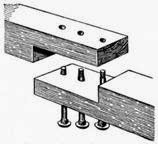
Wedges are tapered pieces of wood which can be used as fixings in the assembly of timber parts. A typical example is the wedges in the figure used to lock the mortise &Tenon.
Dowels
Dowels are rounded or square tapered pieces of timber driven through component parts to join them together.


Adhesives
The types of adhesives (or glues) available are so vast that any material can be pasted to any surface.
Adhesives are divided into two types depending on the method of setting.
Thermoplastic adhesives set either by loss of solvent or by cooling. It will soften again by applying the solvent or by re-heating.
Thermosetting adhesives set and solidify through a chemical reaction and the action is irreversible.

Types of adhesives

Animal glue – Made from hoofs, bones and hides of animals. Avilable in cake form or as small beads. Suitable for internal use and has high gap filling properties.
Fish glue – Made of fish offal and skins. Good for small repair work. Not suitable for structural work.
Casein glue – made from skimmed milk. The powder is mixed with cold water into a creamy paste. Good for internal work only.
Synthetic resins – Synthetic adhesives are very strong, durable and can be used both externally and internally. Some of the common types are:-
  •             Phenol Formaldehyde
  •            Resorption Formaldehyde
  •            Urea Formaldehyde
  •            Melamine Formaldehyde
  •            Polyvinyl Acetate
  •            Polyurethane glue


Friday, March 7, 2014

Timber work 02-Basic tools


Power drills have replaced hand drills and hand braces in timber work because they are faster and easy to operate. Power drills are operated either by electricity (Electric drills) or by compressed air (pneumatic drills).
There are two types of power drills, the heavy duty type and the light duty type. Figure A below shows the heavy duty type and Figure B shows the light duty type.


Normal power drills rotate the drill bit fixed to it at very high speed and make drill holes of required size. In some drills the speed is adjustable according to the cutting material.
Twist drill bits, usually made of High Speed Steel (HSS) are used in drilling wood, steel and other soft metals. Drill bits are available from 1mm diameter to 25mm or more with 0.5mm steps. For portable power drills the maximum drill size is 10 or 12mm.
HSS drill bits are not suitable for drilling masonry. The type of drill bit used for masonry are carbide tipped bits which are used with hammer drills, which have a percussion effect in addition to rotation.
For electrical safety it is best to use power tools rated at 110 volts. Since the normal power supply is 230 volts, a step down transformer 230/110 volt should be used with power tools. For more safety battery operated power drills are now available. Figure below shows a battery operated power drill.

Power drills with variable speeds can also be used as screw drivers to drive and remove screws. 

SANDERS.

Sanders or sanding machines are power tools used to smooth finished frames and wood items.  Sanders have the means to attach sand paper and to move it rapidly over the wood. These may be powered by electricity or compressed air. There are three types of sanders.
      Orbital sanders – In the orbital sander the disk with the sanding pad rotates while moving in an orbital path. This ensures that the sanding material does not travel the same path twice thus ensuring that there are no swirl marks.


2.                          Belt sander is a machine which consists of an electrical motor that turns a pair of drums on which a seamless loop of sandpaper is mounted. Belt sanders can be either hand-held, where the sander is moved over the material, or stationary (fixed), where the material is moved to the sanding belt. Stationary belt sanders are sometimes mounted on a workbench, in which case they are called bench sanders.

Belt Sander                        
 Belt Sander – upside down


The Disk Sander                    


            The Disk Sander is fixed to a work bench and the material to be smoothed is moved over the sanding surface. Disk sanders are dangused to smooth materials such as woods and plastics. It is also used to remove small amounts of waste material. It is a dangerous machine if serous machines and goggles, hand and finger protection must be worn when using

Cleaning and storing portable power tools.


Power tools should be well maintained to give better service and long life. Maintenance of power tools include:
1.      Cleaning after use – Brush or wipe off dust and cut material, lubricate moving parts, clean and check electrical contacts.
2.      Cable care – Check power cable for any damages or loose connections. Promptly replace if damaged. Fold the cable back to position.
Store – Store securely in its proper location with due regard to tool safety and user safety

Timber Work 01-Basic tools


In timber work which involves carpentry, joinery and cabinetry etc quite a number of hand tools are used for different purposes. It is very important to:
1.      Select the proper tool for a given work
2.      Use it correctly
3.      Maintain the tool properly and
4.      Store it safely after use.
Given below are the basic hand tools used in timber vocations, their use, maintenance and storage.
Measuring, marking and checking tools

Steel Ruler
Made of stainless steel. Graduated in 0.5mm (metric) and 1/64”(Imperial).
Measuring is easy because graduations start from the end of the ruler.

Measuring Tape
Graduated in cm and inches.
Easy to use since folds automatically due to spring load.
Mostly used tool for measuring in engineering work.

Try Square
Made with a 90° angle between the stock and blade.
Used to draw lines at right angles to a straight edge or to check squareness.
Divider
Used to transfer measurements from one place to another, and to draw arcs or circles.
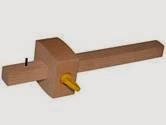
Marking Gauge
Used to draw lines parallel to an edge.
Cutting and paring tools
Hand saw
Types vary on the blade length and No. of Teeth per cm.
Used to cut and separate timber parts.
Cutting should be done at an inclination to the timber.
Tenon Saw
The blade is stiffened by a thick edge opposite the cutting edge.
Used to make precise cuts in jointing timber
Coping Saw
Has a thin blade.
Not suitable for straight cuts.
Used for curved cuts.
Blade is easily breakable.
Hack Saw
Used to cut metal rods, pipes etc.
The blade has to be fixed to the frame.
Blades with appropriate No. of teeth per cm should be selected for different work.
Rip Saw
Used to cut along the grain of timber.
Usually with a long blade.

Planes
Consist of a stock, handle/s, blade and adjusting screw.
Used to make timber surfaces smooth.
Different lengths and shapes are available different types of work.

Chisels
Used for making mortises, chases etc in wood.
Consist of a blade, ferrule and handles.
Heavy duty type chisels have a shock absorber at the ferrule.
There are several types of chisels:
Bevel edge - Bevelled blade for paring and making narrow grooves.
Firmer – Flat blade for heavy, deep cuts.
Mortise – In varying widths for cutting mortises
Gouges – with curved blades for carving work.


Driving Tools
Screw driver
The tip is shaped in three patterns: Flat, Philips head and Star.
Can be selected in many sizes to suit the use.
Used for driving and removing screws.


Hammers
Many types used for many purposes.
Claw hammer – for driving and removing nails.
Ball pein – For riveting
Cross pein – For tinkering work


    Claw Hammer
 

    Cross Pein Hammer
    Ball Pein Hammer


Mallet
Used with the chisel to drive it into timber. Also used for shaping sheet metal.

Rachet Brace
Used for drilling holes of different sizes in wood.
Most suitable for soft wood.
The handle has a rachet which makes it convenient to work in confined spaces.
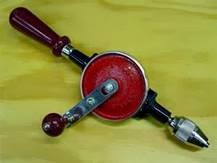
Hand drill and twist drill bits
Counter sink Bit
Twist drill bit
Mostly used for drilling small holes.
Drill bit should be changed according to the drill size.
There are power operated hand drills too.

Bradawl
A tool with pointed blade and handle.
Used to make holes in wood for screws.
Should be used with the mallet.


Maintenance of Tools

Sharpening - Tools should be properly maintained to get the best results. All cutting tools should be sharpened regularly to give a sharp cutting edge. Proper angle of the cutting edge must be maintained when sharpening.
Cleaning – After use tools should be cleaned and wiped. If not intended to be used for a long period of time, the tools should be oiled lightly to prevent rusting.
Storing – Tools when not in use should be stored properly. Tool safety and user safety must be considered when planning storage. One of the most appropriate methods of storing hand tools is to use a shadow board where each tool could be hanged securely and their shadow is painted on the rack/shelf which makes it easy to identify missing tools.


Twitter Delicious Facebook Digg Stumbleupon Favorites More