Showing posts with label Basic Hand Tools-timber. Show all posts

Friday, March 7, 2014

Timber work 02-Basic tools


Power drills have replaced hand drills and hand braces in timber work because they are faster and easy to operate. Power drills are operated either by electricity (Electric drills) or by compressed air (pneumatic drills).
There are two types of power drills, the heavy duty type and the light duty type. Figure A below shows the heavy duty type and Figure B shows the light duty type.


Normal power drills rotate the drill bit fixed to it at very high speed and make drill holes of required size. In some drills the speed is adjustable according to the cutting material.
Twist drill bits, usually made of High Speed Steel (HSS) are used in drilling wood, steel and other soft metals. Drill bits are available from 1mm diameter to 25mm or more with 0.5mm steps. For portable power drills the maximum drill size is 10 or 12mm.
HSS drill bits are not suitable for drilling masonry. The type of drill bit used for masonry are carbide tipped bits which are used with hammer drills, which have a percussion effect in addition to rotation.
For electrical safety it is best to use power tools rated at 110 volts. Since the normal power supply is 230 volts, a step down transformer 230/110 volt should be used with power tools. For more safety battery operated power drills are now available. Figure below shows a battery operated power drill.

Power drills with variable speeds can also be used as screw drivers to drive and remove screws. 

SANDERS.

Sanders or sanding machines are power tools used to smooth finished frames and wood items.  Sanders have the means to attach sand paper and to move it rapidly over the wood. These may be powered by electricity or compressed air. There are three types of sanders.
      Orbital sanders – In the orbital sander the disk with the sanding pad rotates while moving in an orbital path. This ensures that the sanding material does not travel the same path twice thus ensuring that there are no swirl marks.


2.                          Belt sander is a machine which consists of an electrical motor that turns a pair of drums on which a seamless loop of sandpaper is mounted. Belt sanders can be either hand-held, where the sander is moved over the material, or stationary (fixed), where the material is moved to the sanding belt. Stationary belt sanders are sometimes mounted on a workbench, in which case they are called bench sanders.

Belt Sander                        
 Belt Sander – upside down


The Disk Sander                    


            The Disk Sander is fixed to a work bench and the material to be smoothed is moved over the sanding surface. Disk sanders are dangused to smooth materials such as woods and plastics. It is also used to remove small amounts of waste material. It is a dangerous machine if serous machines and goggles, hand and finger protection must be worn when using

Cleaning and storing portable power tools.


Power tools should be well maintained to give better service and long life. Maintenance of power tools include:
1.      Cleaning after use – Brush or wipe off dust and cut material, lubricate moving parts, clean and check electrical contacts.
2.      Cable care – Check power cable for any damages or loose connections. Promptly replace if damaged. Fold the cable back to position.
Store – Store securely in its proper location with due regard to tool safety and user safety

Timber Work 01-Basic tools


In timber work which involves carpentry, joinery and cabinetry etc quite a number of hand tools are used for different purposes. It is very important to:
1.      Select the proper tool for a given work
2.      Use it correctly
3.      Maintain the tool properly and
4.      Store it safely after use.
Given below are the basic hand tools used in timber vocations, their use, maintenance and storage.
Measuring, marking and checking tools

Steel Ruler
Made of stainless steel. Graduated in 0.5mm (metric) and 1/64”(Imperial).
Measuring is easy because graduations start from the end of the ruler.

Measuring Tape
Graduated in cm and inches.
Easy to use since folds automatically due to spring load.
Mostly used tool for measuring in engineering work.

Try Square
Made with a 90° angle between the stock and blade.
Used to draw lines at right angles to a straight edge or to check squareness.
Divider
Used to transfer measurements from one place to another, and to draw arcs or circles.
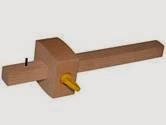
Marking Gauge
Used to draw lines parallel to an edge.
Cutting and paring tools
Hand saw
Types vary on the blade length and No. of Teeth per cm.
Used to cut and separate timber parts.
Cutting should be done at an inclination to the timber.
Tenon Saw
The blade is stiffened by a thick edge opposite the cutting edge.
Used to make precise cuts in jointing timber
Coping Saw
Has a thin blade.
Not suitable for straight cuts.
Used for curved cuts.
Blade is easily breakable.
Hack Saw
Used to cut metal rods, pipes etc.
The blade has to be fixed to the frame.
Blades with appropriate No. of teeth per cm should be selected for different work.
Rip Saw
Used to cut along the grain of timber.
Usually with a long blade.

Planes
Consist of a stock, handle/s, blade and adjusting screw.
Used to make timber surfaces smooth.
Different lengths and shapes are available different types of work.

Chisels
Used for making mortises, chases etc in wood.
Consist of a blade, ferrule and handles.
Heavy duty type chisels have a shock absorber at the ferrule.
There are several types of chisels:
Bevel edge - Bevelled blade for paring and making narrow grooves.
Firmer – Flat blade for heavy, deep cuts.
Mortise – In varying widths for cutting mortises
Gouges – with curved blades for carving work.


Driving Tools
Screw driver
The tip is shaped in three patterns: Flat, Philips head and Star.
Can be selected in many sizes to suit the use.
Used for driving and removing screws.


Hammers
Many types used for many purposes.
Claw hammer – for driving and removing nails.
Ball pein – For riveting
Cross pein – For tinkering work


    Claw Hammer
 

    Cross Pein Hammer
    Ball Pein Hammer


Mallet
Used with the chisel to drive it into timber. Also used for shaping sheet metal.

Rachet Brace
Used for drilling holes of different sizes in wood.
Most suitable for soft wood.
The handle has a rachet which makes it convenient to work in confined spaces.
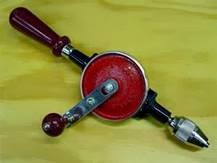
Hand drill and twist drill bits
Counter sink Bit
Twist drill bit
Mostly used for drilling small holes.
Drill bit should be changed according to the drill size.
There are power operated hand drills too.

Bradawl
A tool with pointed blade and handle.
Used to make holes in wood for screws.
Should be used with the mallet.


Maintenance of Tools

Sharpening - Tools should be properly maintained to get the best results. All cutting tools should be sharpened regularly to give a sharp cutting edge. Proper angle of the cutting edge must be maintained when sharpening.
Cleaning – After use tools should be cleaned and wiped. If not intended to be used for a long period of time, the tools should be oiled lightly to prevent rusting.
Storing – Tools when not in use should be stored properly. Tool safety and user safety must be considered when planning storage. One of the most appropriate methods of storing hand tools is to use a shadow board where each tool could be hanged securely and their shadow is painted on the rack/shelf which makes it easy to identify missing tools.


Twitter Delicious Facebook Digg Stumbleupon Favorites More